Fortinet SASE Overview & Pricing Examples
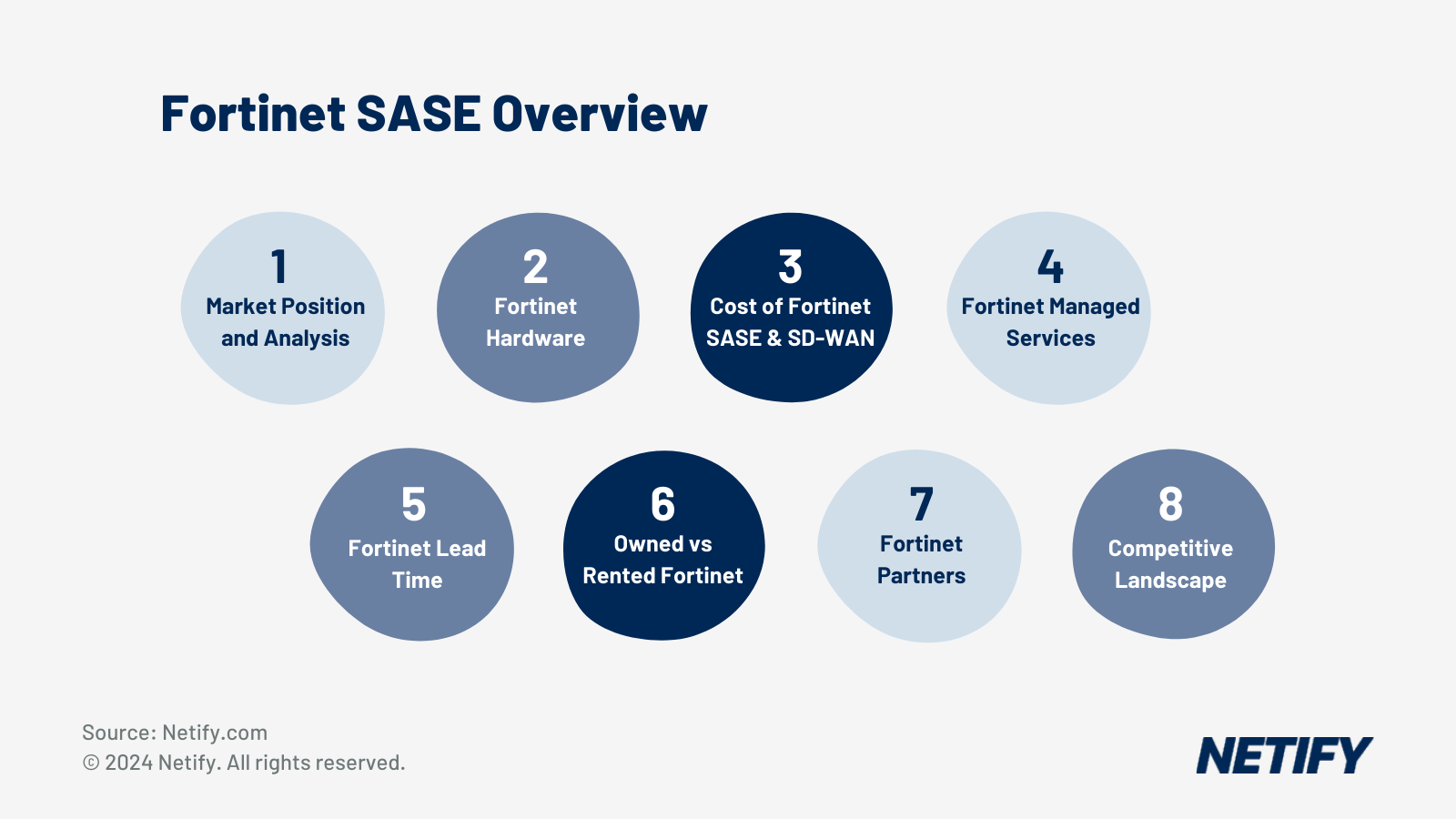
Fortinet is one of the most commonly considered names when UK businesses want their firewall, SD-WAN and SASE under a single vendor, however it can be difficult to tell where Fortinet’s own pricing ends and a partner’s managed service begins.
Continue from this article
Describe what you need
Your first sentence is drafted from this article. Edit it, or replace it with your own words: sites, regions, what must not go down.
Drafted from this article. Everything you type stays yours to edit before you approve any next step.
Compare the research, prepare one brief and choose which suppliers Netify may approach.
Your requirements open in the private sourcing journey. Review the evidence, choose recipients and confirm your work email before Netify reviews an introduction. A full RFP can follow from the same brief.
Take these requirements into provider sourcingSupplier responses depend on the scope and the suppliers accepting the request. No supplier is contacted by opening this page.
Working with an assistant? Connect netify.co.uk/sase/api/mcp/ and use prepare_sourcing_plan with this page as context.
We’ve covered the current Fortinet position as of November 2026, including where it sits in the market, the hardware and licensing behind it, what it costs in the UK and how it can be bought through BT Managed SD-WAN and BT Managed SASE. Quite a lot has changed since the previous version of this article, with Fortinet now being a Challenger in Gartner’s 2026 Magic Quadrant for SASE Platforms, the FortiGate 100F and 200F no longer being available to order and list prices rising due to a global memory chip shortage.
Where does Fortinet sit in the SASE market?
Fortinet is a Challenger in Gartner's 2026 Magic Quadrant for SASE Platforms, published on 28 July 2026, whereas the previous version of this article described it as a Leader. However, Fortinet does still hold a Leader placement in Gartner's 2026 Magic Quadrant for Hybrid Mesh Firewall, positioned highest for Ability to Execute for the second year running.
On scale, Fortinet reported FY2025 revenue of $6.80bn (up 14%) and “well over half a million” customers, with third quarter 2026 revenue of $2.08bn (up 20% year on year) and 2026 revenue guidance raised to $8.125bn. Management also reported that SASE Firewall billings (the combined firewall, SD-WAN and SASE category) grew 31% in the third quarter.
However, for most UK organisations, the decision that matters more than the market placement is whether you’d like to run the platform yourself or have it managed, which we cover in the BT section further down.
What does Fortinet say its SASE covers?
FortiSASE offers organisations with the ability to:
- Secure your hybrid workforce, which means zero trust and zero trust network access (ZTNA) for remote and branch users.
- Get network and security visibility across the organisation, which combines Fortinet’s WAN, LAN, WiFi and end-user products.
- Modernise to a zero-trust architecture, which is based on giving users just enough access to each application.
- Protect internet access, private access and SaaS access, which in Fortinet’s range includes Secure Internet Access (SIA).
Fortinet's SASE strategy combines different security and network services to ensure safe and uninterrupted access to applications, no matter where they are used.
Why does the single-vendor approach matter?
Fortinet builds its SASE functions natively on FortiOS, meaning that they don’t acquire or partner with third parties to fill capability gaps. The same operating system runs on the on-premises FortiGate and in the cloud PoPs (where FortiOS is deployed as virtual machines), so ZTNA, SD-WAN and inline security share one codebase and the same FortiGuard threat intelligence.
For organisations already running FortiGates, we’d suggest that the main benefit is policy consistency, as your existing security rules and FortiGuard signatures carry across into FortiSASE without a policy redesign, and moving to SASE doesn’t mean ripping out the network security you’ve already bought.
There is a trade-off though - FortiOS running in virtual machines isn’t a cloud-native micro-services design, which is how the likes of Zscaler and Netskope built their platforms. We’d expect that to make little practical difference for most mid-market and standard enterprise deployments, however can be a sticking point if you have a very large cloud-first estate.
Which FortiGate models suit SD-WAN and SASE branches in 2026?
Whilst the 100F and 200F can no longer be ordered, the 40F and 60F remain on sale for small sites, with the G-series 120G and 200G available for larger scale estates.
Model | SSL inspection throughput | Status |
FortiGate 40F | 310 Mbps | Current |
FortiGate 60F | 630 Mbps | Current |
FortiGate 100F | 1 Gbps | End of order 16 April 2026 |
FortiGate 120G | 3 Gbps | Current |
FortiGate 200F | 4 Gbps | End of order 1 March 2026 |
FortiGate 200G | 7 Gbps | Current |
How much does Fortinet SD-WAN and SASE cost in the UK?
We’ve collated the below published UK list prices (ex VAT), however Fortinet doesn’t sell to the end user directly and so doesn’t set the final price, which means a partner’s status or margin decision can move your cost.
Model | Hardware | 3-year UTP bundle | 3-year Enterprise bundle |
FortiGate 40F | £703.36 | £1,617.00 | £1,812.78 |
FortiGate 60F | £797.62 | £2,020.38 | £2,282.40 |
FortiGate 120G | £4,440.10 | £11,140.14 | £12,575.86 |
It’s worth noting that there’s no separate SD-WAN licence on a FortiGate, whilst FortiSASE is priced per user per year across the Standard, Advanced and Comprehensive tiers.
Renewals need the same attention as the first purchase, as service and support fees are tied to the hardware price, so any list-price rise feeds straight into what you pay at renewal - we’d recommend getting quotations from more than one partner and asking each about year-on-year price changes at renewal, particularly for the UTP licence.
How easy is Fortinet to manage?
Managing Fortinet is one of the biggest downsides we’ve noted customers make complaints about – where we’d suggest that Fortinet’s management is less intuitive than many of the alternative dedicated cloud-native competitors and this further exaggerates the learning curve for teams without prior Fortinet experience.
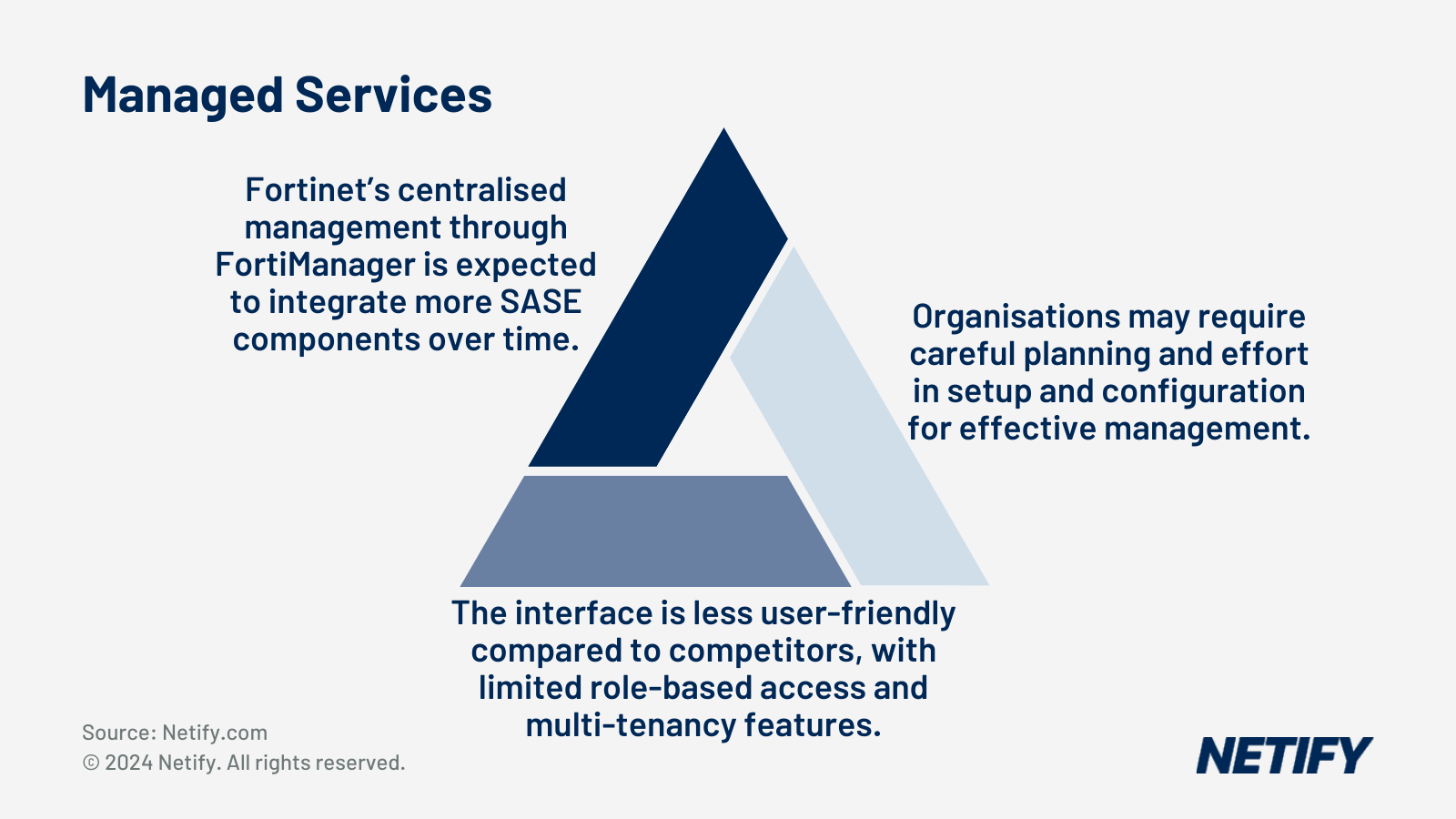
On a positive note, when it comes to managing analytics and data, Fortinet SASE can take from their NGFW, SD-WAN and ZTNA components, allowing all of this data to be stored, viewed and analysed in FortiAnalyzer, with the relevant data sent on to third-party SIEM and SOAR tools.
However, to add to FortiSASE’s criticisms, their role-based access controls and multi-tenancy are also less flexible than on purpose-built SSE platforms, which can be significant for organisations with several business lines or a decentralised IT team (grouping configuration by division and changing policy on a per-group basis is limited).
What does a Fortinet implementation involve?
Fortinet SD-WAN is included on the FortiGate at no extra licence cost, so existing Fortinet customers can switch it on through FortiOS. However, it’s worth noting that FortiDeploy is required for zero-touch provisioning, and without it set-up is more manual, with DNS and DHCP to be configured at each site.
When implementing Fortinet SD-WAN, Fortinet publishes reference architectures that explain the recommended configurations, which are useful if you’re setting the network up yourself, however if you’re unsure or want an expert to advise you through the process, we’d always recommend engaging an experienced individual (such as those at Netify or BT if ordering a BT managed SD-WAN service).
Does Fortinet offer professional services?
Yes, Fortinet does offer professional services, such as support for builds and implementation, as well as during service, though this is typically more geared towards complex security deployments such as data centres, whereas for smaller scale or simplified deployments, partners are often better to support these customers. In our view partners with deep SD-WAN experience are likely to be the more cost-effective and timely option.
What do buyers expect from a managed WAN?
Fortinet is sold through a wide partner ecosystem (with BT being one of them, in which we’ve covered below) and each partner has varying capabilities, expertise and in-life management options. Companies are asking more of a managed WAN, such as:
- Co-managed: the ability to make small moves, adds and changes without lengthy and sometimes costly changes through the managed service partner.
- Underlay: a broader choice of circuits, instead of being restricted to the partner’s network.
- Single point of contact: the ability to procure third-party circuits and have them managed by one partner.
How do you buy Fortinet through BT Managed SD-WAN and SASE?
BT supplies Fortinet SD-WAN as a fully managed service, with BT providing the devices and software licences and offering FortiSASE licences (bandwidth, public IP and remote user) as an optional enhancement, as well as a separate FortiSASE service.
One of the key benefits of purchasing BT’s managed SASE over Fortinet standalone is that it not only comes as a managed offering for greater support, but also suits organisations that want one contract and one SLA (whereas a self-managed Fortinet purchased from a reseller suits teams with in-house network security skills and for those utilising diverse network connectivity).
Interested in speaking with a Netify expert about BT’s Managed Fortinet SD-WAN and SASE offerings?
Get in touch with our experts to find out how BT Managed SASE with Fortinet can work for your enterprise network.
Should you own or rent the WAN?
Historically the WAN, circuits and routers have been consumed as a rented service over a multi-year term (3 or 5 years). More businesses are now exploring uncoupling the overlay from the underlay, driven by SaaS adoption, the move to public cloud and the hybrid workforce, as it’s no longer only about connecting and protecting offices and servers.
What is a Fortinet Enterprise Agreement?
For larger estates, Fortinet’s Enterprise Agreement moves support and licensing to an account-based model with price protection and a hardware discount framework for the agreement term, plus a growth allowance. Given that this can significantly lower costs, we’d always recommend asking your reseller whether your estate is large enough to qualify.
Where does Fortinet fall short?
Whilst FortiSASE is often praised as solid, cost-effective, and tightly integrated with FortiGate, we’ve noticed that many customers have said that the platform can be somewhat cumbersome, and less polished than other SASE platforms. At Netify, we’ve seen Fortinet steadily improve their management tooling but there’s still a lack of granular controls for administering rules.
Furthermore, FortiSASE is very much geared towards organisations with existing FortiGate estates - an organisation with a cloud-first or heavily SaaS-centred posture and no existing Fortinet estate should, in our opinion, consider alternative options such as the likes of Zscaler, Netskope and Cato Networks before committing.
Conclusion
Overall, we’d say Fortinet remains a strong choice for security-focused organisations that want their firewall, SD-WAN and SASE on a single platform, particularly if you already run FortiGates, as moving to SASE means your existing policies carry across with no rip-and-replace. Whilst the move down to Challenger is worth noting, we’d suggest the bigger decision for most UK organisations is whether you’d like to run the platform yourself or have it managed through BT, and given that list prices are rising, we’d always recommend getting current quotes for the exact model, term and tier.
However, if you’re cloud-first with no existing Fortinet estate, we’d suggest looking at the likes of Zscaler, Netskope and Cato Networks alongside it before committing. At Netify, we’d recommend including Fortinet in any SASE shortlist where branch SD-WAN is part of the scope, and if you’d like help scoping either the managed or self-managed route, please feel free to reach out to our team.

Harry holds a BSc (Hons) in Computer Science from the University of East Anglia and is ISC2 Certified in Cybersecurity (CC). He serves as a Cybersecurity Writer here at Netify, where he specialises in enterprise networking technologies. With expertise in Software-Defined Wide Area Networks (SD-WAN) and Secure Access Service Edge (SASE) architectures, Harry provides in-depth analysis of leading vendors and network solutions.
Fact checked by: Robert Sturt - Managing Director, Netify
Frequently Asked Questions
Does Fortinet SD-WAN or FortiSASE need a separate licence?
Fortinet Secure SD-WAN can be configured on any FortiGate without a separate licence, however FortiSASE Secure Edge does need its own subscription for each FortiGate appliance.
Can I buy Fortinet SD-WAN or SASE as a managed service?
Yes, FortiSASE is offered through BT Managed SD-WAN and BT Managed SASE - which, as an Authorised Partner of BT, Netify can scope and supply for you.
Is Fortinet a Gartner Leader for SASE?
No - whilst Fortinet had been moved up to a Leader in the 2025 edition of Gartner’s SASE magic quadrant, for 2026 Gartner moved Fortinet back down to a Challenger, though it’s worth noting that Fortinet is also a Leader in Gartner’s 2026 Hybrid Mesh Firewall magic quadrant, making it a good choice for security-focused businesses.
What is FortiSASE?
FortiSASE is Fortinet’s cloud-delivered SASE service, which extends the FortiGate security stack into a per-user cloud subscription. It covers the likes of secure internet access and secure SaaS access, all using the same FortiOS and FortiGuard threat intelligence as the on-premises appliances, as well as being delivered from over 200 PoPs (including London and Leeds in the UK).
Is Fortinet a single-vendor SASE?
Yes - the firewall, SD-WAN and SASE functionality all run together on a single FortiOS operating system, which avoids potential issues we commonly see arise with the dual-vendor approach of pairing an SD-WAN vendor with a separate SSE vendor, meaning that with Fortinet, there’s less chance of policy fragmentation and extra management overhead (from managing multiple separate systems).
How does Fortinet SASE compare to Zscaler?
In our opinion, FortiSASE is by far the stronger choice for organisations already running FortiGate hardware, especially given their tight integration for branch SD-WAN and remote user security. We’d also suggest that Fortinet offers greater security capabilities generally, therefore for security-conscious organisations, Fortinet is the ideal choice over the likes of Zscaler.
However, where organisations operate larger, cloud-first network architectures that prioritise purpose-built micro-services and SSE architecture with no on-premises SD-WAN requirements, Zscaler is a better choice when compared to Fortinet.
Is the FortiGate 100F still available?
No, the FortiGate 100F edge appliance (that appeared on previous revisions of this page) reached end of order on 16 April 2026, with support running to 16 April 2031.