Which UK Providers Still Offer VPLS, and How It Works with SD-WAN (2026)
Virtual Private LAN Service (VPLS) remains one of the most commonly sought-after ways for UK businesses to privately extend their LAN across multiple sites, however with so many providers now selling it under different names, such as Ethernet VPN or E-LAN, it can be difficult to determine who still offers it. At the same time, more and more businesses are rolling out SD-WAN across their sites, which leaves a lot of IT teams asking whether VPLS still has a place alongside it, and in our view it does, as long as it’s kept for the sites that genuinely need a shared LAN.
Continue from this article
Describe what you need
Your first sentence is drafted from this article. Edit it, or replace it with your own words: sites, regions, what must not go down.
Drafted from this article. Everything you type stays yours to edit before you approve any next step.
Compare the research, prepare one brief and choose which suppliers Netify may approach.
Your requirements open in the private sourcing journey. Review the evidence, choose recipients and confirm your work email before Netify reviews an introduction. A full RFP can follow from the same brief.
Take these requirements into provider sourcingSupplier responses depend on the scope and the suppliers accepting the request. No supplier is contacted by opening this page.
Working with an assistant? Connect netify.co.uk/sase/api/mcp/ and use prepare_sourcing_plan with this page as context.
In this guide, we’ve compared seven UK providers that still supply multipoint Layer 2 connectivity, which are BT, Colt, GTT, Virgin Media Business, Vodafone Business, Exponential-e and Cogent, to highlight how each one sells it and which is the best fit for your sites. We’ve also covered how VPLS integrates with SD-WAN, including the three main ways to combine them, to help you decide whether to buy Layer 2 from a carrier, build it over your SD-WAN or use a mix of both.
Our take
With so many names for what is essentially the same service, it’s easy to shortlist the wrong suppliers or miss the right ones altogether, so before you start we’d strongly recommend that you consider these key points:
Search for E-LAN and Ethernet VPN as well as VPLS
GTT, Exponential-e and Cogent are the only three still leading with the VPLS name, whilst BT, Colt, Virgin Media Business and Vodafone Business sell the same service as E-LAN or Ethernet VPN, so it’s worth looking at these services for what are essentially the same product.
Only buy Layer 2 for the sites that need it
VPLS earns its place where sites need to share LAN addressing or carry non-IP and legacy traffic (data centre pairs and campus buildings being a good example), whilst branch offices and remote users are better served by SD-WAN, so we’d recommend keeping your Layer 2 footprint as small as your applications allow.
BT is the safest UK-wide entry on the shortlist, with Colt the strongest on fibre
BT's Ethernet Connect E-LAN is MEF certified and runs from 200kb up to 10Gb with a choice of traffic classes, whilst Colt's Ethernet VPN suits sites in buildings and data centres on its own fibre, although off-net sites rely on third-party circuits.
GTT is the one to look at for multi-country networks
GTT still sells the service as VPLS, carries non-IP traffic with no encapsulation or conversion and includes four classes of service at no additional cost, so we'd shortlist it where your sites span several countries and ask which UK points of presence will serve each one.
SD-WAN and VPLS work best together
The simplest pairing is a VPLS or E-LAN circuit terminating on the SD-WAN edge as one of several WAN links, with Layer 2 over the SD-WAN overlay as the lower-cost alternative for a handful of sites, although that runs over internet links and so doesn't come with a carrier's latency commitments.
Settle the SLA and the pricing basis before you compare quotes
Pricing for multipoint Layer 2 is quoted per project, depending on the access type, bandwidth and number of sites, so we'd always get the SLA, fault fix times and access type for every site in writing and ask whether you're charged per site port or per virtual connection.
Our BT route suits buyers who want one supplier for both layers
At Netify we can assist with your procurement of BT services, who supplies both Ethernet Connect and managed SD-WAN on Meraki or Fortinet, which means with Netify you can get a single BT design to cover both the Layer 2 and SD-WAN layer together.
What is VPLS and when do UK businesses need it?
VPLS (Virtual Private LAN Service) is a Layer 2 service that makes a provider’s MPLS network behave like one large Ethernet switch, so every site you connect appears to sit on the same LAN even when they’re in different towns or countries.
Each site is handed over as a standard Ethernet port, and the provider’s network learns and forwards traffic by MAC address in the same way a switch would, which is why your own VLANs, IP addressing and routing protocols can pass straight across without the provider getting involved in any of them.
Comparing VPLS vs MPLS, which one is right for you?
Layer of Operation
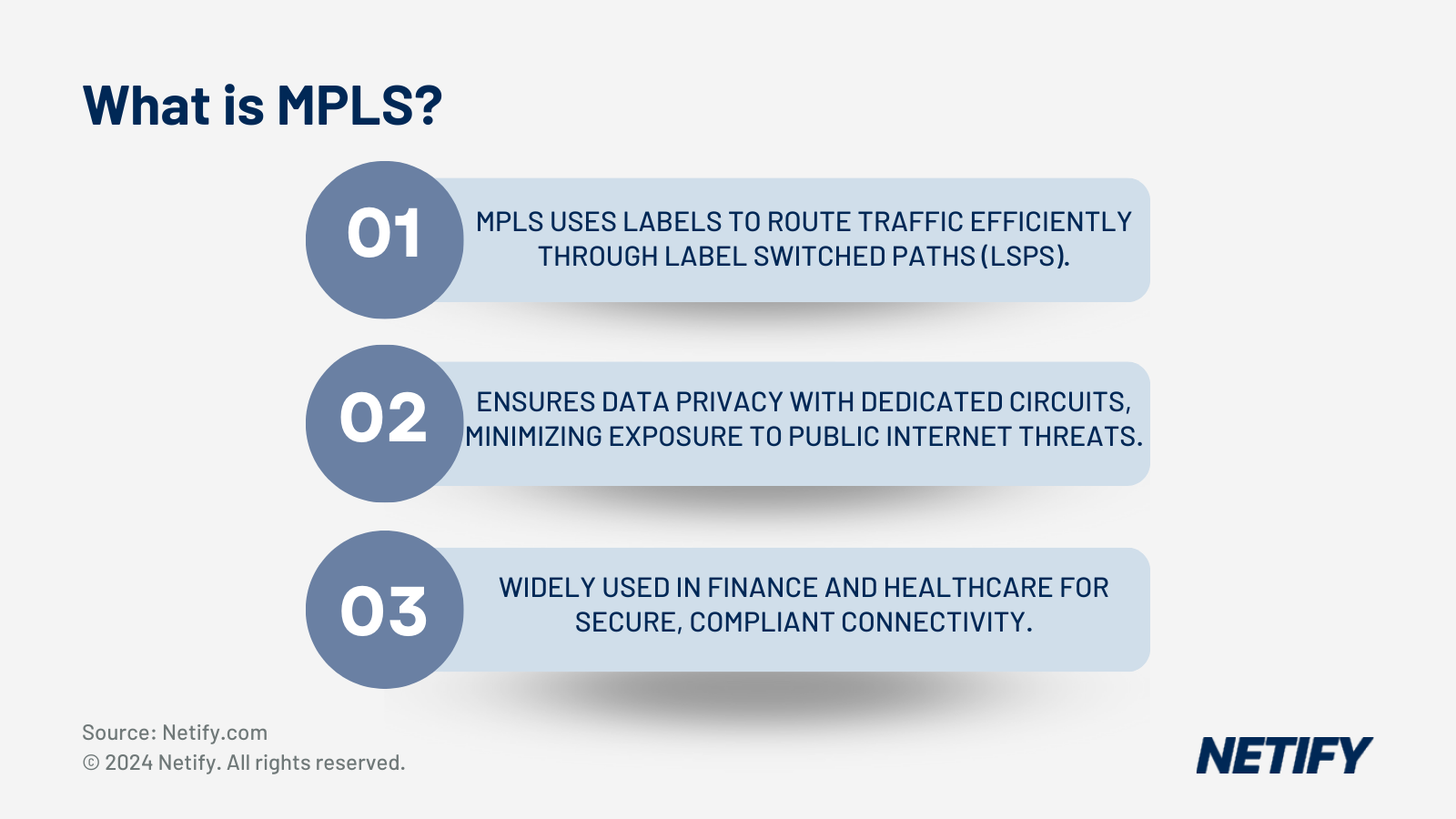
MPLS operates at layer 3 of the OSI model, meaning that forwarding decisions are based on the IP address, so extending LAN services is not possible. Layer 2 VPLS operates at layer 2, creating virtual LANs over wide area networks where there is a need to extend Ethernet-based connectivity between branch offices. The way to think of VPLS and MPLS is that they are broadly the same as both services are provisioned over a service provider network infrastructure. The business connects to the service provider network to extend their reach; the choice of VPLS vs MPLS is dependent on whether LAN extension is required.
Scalability
MPLS is perceived as more scalable when compared to VPLS, but only very large deployments need to be mindful of scaling issues. VPLS is scalable within the context of extending Ethernet LAN services for the majority of business sizes; there could be limitations if the VPLS services are required at scale.
Control and Routing
With MPLS solutions, the service provider is responsible for the control of routing decisions and network management. VPLS hands over control of these elements to businesses; routing and VLANs can be controlled by your IT team, allowing management of layer 2 network traffic independently of the service provider network.
Use Case Suitability
MPLS is better suited for organisations that require private connectivity where the control aspect is firmly within the IP routing realm. Although MPLS has declined, industries needing strong QoS and secure WAN connectivity may still opt for a hybrid of SD-WAN and MPLS.
VPLS is a good fit for businesses looking to extend their LAN across dispersed locations without the need to route at the IP level. We are seeing more businesses with VPLS and SD-WAN hybrid networks compared to MPLS and SD-WAN hybrid networks.
What is the difference between VPLS, E-LAN, EVPN, MPLS IP VPN and SD-WAN?
With so many options available for business networking, it can be difficult to decipher and differentiate between the likes of VPLS, E-LAN, EVPN, MPLS IP VPN and SD-WAN, all of which appear at first glance to offer similar services. To make matters worse, these terms get used loosely in this market, and providers often swap between them on the same product page, so to avoid any confusion the key difference is the layer each one works at and how much of the routing you control.
VPLS and E-LAN describe the same kind of service, with VPLS being the technology that makes a provider's MPLS network behave like one large Ethernet switch and E-LAN the name the MEF gives to the any-to-any service you actually buy. Behind the scenes, Juniper notes that provider networks are migrating from VPLS to EVPN because of the scaling benefits, but that's a change inside the provider's core and what's handed over at your site stays a standard Ethernet port carrying your own VLANs. As a rule of thumb, we'd ask which technology sits underneath, but we'd judge the service on what you receive at each site and on the SLA behind it. The differences are set out below:
Term | What it is | Who it suits | What you control | Examples |
VPLS | A layer 2 service that makes the provider's MPLS network behave like one Ethernet switch | Sites that need shared LAN addressing or carry non-IP and legacy traffic | Your own VLANs and routing | GTT, Exponential-e, Cogent |
E-LAN (Ethernet VPN) | The MEF name for an any-to-any layer 2 service | The same buyers as VPLS | Your own VLANs and routing | BT, Colt, Virgin Media Business, Vodafone Business |
EVPN | A BGP-based control plane that providers are migrating to from VPLS | Not usually bought by name, as it sits inside the provider's core | Nothing directly, as it's delivered as the same Ethernet handoff | Provider networks |
MPLS IP VPN | A layer 3 service where forwarding is based on IP addresses and the provider shares in the routing | Sites that need private IP routing without extending the LAN | IP addressing, with routing decisions shared with the provider | Most large carriers |
SD-WAN | A layer 3 overlay that makes use of whatever circuits you give it | Branch offices and remote users | Policies and path selection | Managed SD-WAN providers and vendors |
Layer 2 over SD-WAN | Ethernet frames carried in VXLAN tunnels across the SD-WAN overlay, using EVPN for MAC and VLAN reachability | A handful of sites, OT networks and retail estates on a tight budget | The layer 2 domain across your internet links | Versa and other SD-WAN vendors |
How does VPLS integrate with SD-WAN?
Much like the MPLS vs SD-WAN debate, it can be tempting to pit VPLS against SD-WAN when comparing network solutions. However, VPLS and SD-WAN aren't really competing choices, as SD-WAN is built to use whatever transport it's given, so a VPLS circuit slots in as another private WAN link, and it’s becoming more common for businesses to utilise VPLS and SD-WAN hybrids than MPLS and SD-WAN ones. There are three main ways to combine them, which are:
- VPLS as an underlay beneath the SD-WAN,
- Layer 2 stretched across the SD-WAN overlay itself,
- A hybrid where VPLS links the sites that need Layer 2 and SD-WAN covers everything else.
In the first, your VPLS or E-LAN circuits terminate on the SD-WAN edge as one of several WAN links alongside broadband, 4G or 5G. The SD-WAN steers traffic across them by application, so the private path carries what needs it whilst the internet links handle the rest and act as backup. We'd say it's the simplest way in where you already have VPLS and want to add SD-WAN steering and cloud breakout without replacing the circuits.
The second route skips the carrier's Layer 2 service altogether. Several SD-WAN vendors (Versa being one example) support Layer 2 over SD-WAN, which encapsulates Ethernet frames in VXLAN tunnels and uses EVPN to distribute MAC and VLAN reachability across sites, with the tunnels encrypted using IPsec or WireGuard on some platforms. Versa positions this as a way of avoiding dependence on costly provider MPLS connectivity, and typical uses include factory automation, retail chains with centralised services and other OT networks. In our view this suits a handful of sites on a tight budget, however it runs over an internet underlay so you don't get the latency commitments of a carrier VPLS, and we'd ask your SD-WAN vendor to confirm in writing which Layer 2 features your edge hardware supports.
The third route is the one we'd recommend most often, with VPLS kept for the sites that genuinely need a shared broadcast domain (such as data centre pairs, campus buildings and locations running non-IP or legacy applications) and SD-WAN used for branch offices and remote users. The three routes compare as follows:
Route | How it works | Best for | What to watch |
VPLS under SD-WAN | VPLS or E-LAN circuits terminate on the SD-WAN edge as one of several WAN links | Estates that already have VPLS and want SD-WAN steering and cloud breakout | The edge must be able to carry your VLANs, not just route |
Layer 2 over SD-WAN | VXLAN tunnels with EVPN carry Ethernet frames across the overlay | A handful of sites, OT networks and retail estates on a tight budget | No carrier latency commitments, and Layer 2 support varies by edge hardware |
Hybrid | VPLS links the Layer 2 sites whilst SD-WAN covers branches and remote users | Mixed estates with data centres or campuses alongside many branches | Two services to manage, so we'd keep the Layer 2 footprint small |
Whichever route you take, we'd always recommend confirming the following with your provider and your SD-WAN vendor before you order:
What to confirm | Why it matters |
Whether the SD-WAN edge can bridge Layer 2 or only route | This decides whether your VLANs can pass through the edge at all |
How loops and broadcast storms are contained | A stretched Layer 2 domain widens the area an outage can affect |
The MTU across the whole path | VXLAN encapsulation adds overhead to every frame |
Whether traffic is encrypted | A private Layer 2 service isn't encrypted by default, and some providers offer encryption as an option |
How failover behaves when the VPLS circuit drops | You need to know whether Layer 2 traffic can move onto an overlay tunnel or only IP traffic can |
Which approach suits which type of network?
The right answer depends mostly on where your sites are and how many of them really need Layer 2, so we've matched the common situations to the approach we'd recommend:
Your situation | What we'd recommend | Why |
UK-wide estate with sites in many towns | BT Ethernet Connect E-LAN, with SD-WAN on top | Nationwide coverage, a choice of traffic classes and one supplier for both layers |
Data centres or offices in buildings on fibre | Colt Ethernet VPN | On-net fibre sites suit Colt best, with an on-net check for every address |
Sites across several countries | GTT VPLS | It still sells VPLS as a named product and carries non-IP traffic without encapsulation |
An estate that keeps adding sites | Virgin Media Business Ethernet VPN | Each new site needs one connection rather than two |
A handful of sites on a tight budget | Layer 2 over SD-WAN | It avoids buying a carrier Layer 2 service, though without carrier latency commitments |
Non-IP or legacy applications between sites | Carrier VPLS or E-LAN | Strict Layer 2 transparency is where the carrier service is most dependable |
What should you ask a provider before you sign?
Given that the vast majority of the multipoint Layer 2 market quotes per project, we’d recommend asking the following questions to each provider on your shortlist to ensure you’re getting the service your business requires:
Check | What to ask for in writing |
SLA and fault handling | The availability commitment, the fault fix times and how service credits are claimed |
Access type per site | Whether each site is on-net, off-net or on a third-party circuit, as that drives delivery time and resilience |
Layer 2 limits | How many VLANs and MAC addresses the service supports, and which Layer 2 control protocols it passes |
Underlying technology | Whether the service runs on VPLS or EVPN, and how long the provider commits to supporting it in the contract |
Pricing basis | Whether you're charged per site port or per virtual connection, and what each extra site costs |
Encryption | Whether encryption is available and whether it's included or an optional extra |
Which providers still offer VPLS in the UK?
There are seven UK providers still supplying multipoint Layer 2 connectivity, and whilst they all offer the same basic service of joining your sites into one any-to-any Ethernet network, they differ on what they call it, how far their reach goes and how they price it. To assist with this, we’ve broken down the main differences between each one below.
BT sells multipoint Layer 2 as Ethernet Connect UK E-LAN, with circuits from 200kb up to 10Gb and a choice of Standard or Premium traffic classes, and it’s MEF certified to MEF 9 and 14. In our view, BT is the strongest first name on a UK-wide shortlist, however as we have a commercial interest in BT (which we’ve made clear throughout), we’d always recommend benchmarking it against a fibre-led alternative such as Colt, and getting the SLA, fault fix times and access type for every site in writing.
Colt sells its service as Ethernet VPN (E-LAN) on its IQNet platform, which is certified to the MEF 3.0 standard, and it’s the one to check if you’ve inherited a Lumen EMEA contract, as existing Ethersphere VPLS services continue on their current platforms whilst new services are built on IQNet. We’d say Colt is the natural pick where your sites are in buildings or data centres on its fibre, though as off-net sites use third-party leased lines, we’d recommend asking for an on-net check on every address, since that changes the delivery time and the resilience you can expect.
GTT still markets the service under the VPLS name, pitching any-to-any connectivity with no sharing of your routing table or IP addressing, non-IP traffic carried without encapsulation and four classes of service at no extra cost. Our suggestion would be to shortlist GTT where your network spans several countries, and to ask which UK points of presence and access partners will serve each of your sites before you commit.
Virgin Media Business charges for Ethernet VPN based on the cost of connecting each site to the VPN rather than site to site, so each extra site only needs one connection instead of two, which we’d say makes it one to price for an estate that keeps adding sites. Vodafone Business sells Ethernet VPN with you keeping control of your own routing, whilst Exponential-e launched what it describes as the world’s first VPLS in 2006 and still publishes VPLS guidance today, and Cogent lists multipoint Ethernet and VPLS within its Ethernet services. For these four, we’d recommend asking each provider to confirm UK availability at your postcodes, the bandwidth tiers and the SLA in writing.
Provider | How it's sold | What stands out | Best suited to |
Ethernet Connect UK (E-LAN), with Etherflow Dynamic through BT Wholesale | MEF 9 and 14 certified, circuits from 200kb to 10Gb, Standard or Premium traffic classes | UK-wide coverage with a BT-managed service | |
Ethernet VPN (E-LAN) | IQNet platform certified to MEF 3.0, existing Lumen Ethersphere VPLS services continue | Sites in buildings or data centres on Colt's fibre | |
VPLS | Any-to-any, non-IP traffic carried without encapsulation, four P-bit classes of service at no extra cost | Networks that span several countries | |
Ethernet VPN | Charged per connection to the VPN rather than site to site | Estates that keep adding sites | |
Ethernet VPN | You control data routing, with Ethernet products from 10Mbps to 100Gbps across the range | Keeping your own routing control | |
VPLS | Launched what it describes as the world's first VPLS in 2006 | Buyers wanting a UK specialist with a long VPLS track record | |
Cogent | Ethernet multipoint and VPLS | Listed within its Ethernet services | Cost-led Ethernet networks |
Full UK VPLS Providers Comparison?
1. BT Business (Ethernet Connect UK E-LAN)
BT sells its multipoint Layer 2 service as Ethernet Connect UK, a layer 2 Ethernet WAN service connecting sites in the UK, with E-LAN being the any-to-any option that BT's own global pages note is also known as VPLS. E-LAN circuits run from 200kb up to 10Gband the service is certified by the MEF to MEF 9 and 14.
In our view, BT is a strong first name on a UK-wide shortlist, however as we have a commercial interest in BT (which we've made clear throughout), we'd always recommend benchmarking it against a fibre-led alternative such as Colt. We'd also ask BT for the availability and fault repair commitments for every site in writing, as the service levels sit in Part C of the Ethernet Connect UK schedule.
Key features
- A UK-wide layer 2 Ethernet service for connecting your sites.
- E-LAN circuits from 200kb up to 10Gb.
- A choice of traffic classes to prioritise your traffic.
- MEF 9 and 14 certification.
- Availability with managed CPE.
Example partnerships
BT Wholesale offers a similar any-to-any layer 2 product called Etherflow Dynamic, which communications providers can build on to supply their own customers.
2. Colt (Ethernet VPN)
Colt sells its multipoint service as Ethernet VPN (E-LAN), a switched Layer 2 service that gives any-to-any connectivity between sites, delivered on its IQNet platform, which is certified to the MEF 3.0 standard. The wider Colt IQ Network covers 29,000 on-net buildings and over 900 data centres across Europe, Asia and North America, however that isn't a UK figure, and for UK reach we'd point to the CityFibre partnership covered below.
Colt has also been moving former Lumen EMEA Ethernet customers across, with existing Ethersphere VPLS services continuing on their current platforms and new services built on IQNet, which is worth knowing if you've inherited a Lumen contract. We'd say Colt is the natural pick where your sites are in buildings or data centres on its fibre, and as off-net buildings are connected using third-party leased lines, we'd always ask for an on-net check for every address.
Key features
- Ethernet VPN (E-LAN) as a switched layer 2, any-to-any service.
- An IQNet platform certified to MEF 3.0.
- 29,000 on-net buildings and more than 900 data centres across Europe, Asia and North America.
- More than 7,000 additional virtual on-net buildings in the UK through CityFibre.
- Off-net sites connected using third-party leased lines.
Example partnerships
Colt's partnership with CityFibre extends its UK metro reach, adding more than 7,000 virtual on-net buildings across seven new cities.
3. GTT (VPLS)
GTT still markets the service under the VPLS name, with its product page current as of 12 May 2026. It pitches any-to-any connectivity where you keep full routing control with no sharing of your routing table or IP addressing, carries non-IP traffic with no encapsulation or conversion and includes four classes of service through P-bit prioritisation at no additional cost.
GTT says its Tier 1 network has 400+ PoPs and client services in 170+ countries, though it quotes different country counts on different pages, so we'd ask which UK PoPs and access partners will serve each of your sites rather than relying on the global figure. Our suggestion would be to shortlist GTT where your network spans several countries.
Key features
- Any-to-any VPLS with full control of your own routing.
- Non-IP traffic carried without encapsulation or conversion.
- Four P-bit classes of service at no additional cost.
- A 24/7 NOC and the EnvisionDX customer portal.
Example partnerships
GTT privately interconnects with cloud service providers, which is how its VPLS can be tied into cloud platforms.
4. Cogent (Ethernet multipoint and VPLS)
Cogent lists multipoint Ethernet and VPLS within its Ethernet services, positioning them as simple, flexible and cost-effective, which makes it the one we'd look at for cost-led networks. Cogent reports 3,605 on-net buildings at the end of Q1 2026, however that covers its whole network, so we'd ask for the UK on-net position at your sites, along with the SLA and class of service options in writing, before you shortlist it.
Key features
- Multipoint Ethernet and VPLS within its Ethernet range.
- Positioned as a cost-effective option.
- 3,605 on-net buildings across its network.
5. Virgin Media Business (Ethernet VPN)
Virgin Media Business sells Ethernet VPN, with charges based on the cost of connecting to the VPN rather than site to site, so each additional site only needs one connection to its network instead of two. It's also built to complement existing LAN technology, and we'd say that makes it one to price for an estate that keeps adding sites, though we'd ask Virgin Media Business to confirm UK availability at your postcodes and the SLA in writing.
Key features
- Ethernet VPN as a multipoint layer 2 service.
- Pricing based on the connection to the VPN, not site to site.
- Designed to complement your existing LAN.
- Delivered over its MPLS network, which provides an Ethernet Virtual Connection between the access circuit and a customer interconnect point.

Harry holds a BSc (Hons) in Computer Science from the University of East Anglia and is ISC2 Certified in Cybersecurity (CC). He serves as a Cybersecurity Writer here at Netify, where he specialises in enterprise networking technologies. With expertise in Software-Defined Wide Area Networks (SD-WAN) and Secure Access Service Edge (SASE) architectures, Harry provides in-depth analysis of leading vendors and network solutions.
Fact checked by: Robert Sturt - Managing Director, Netify
Frequently asked questions
Is VPLS still available in the UK?
Yes, VPLS is still widely available throughout the UK, though it’s worth noting that it's more often than not being sold under another name. Whilst GTT, Exponential-e and Cogent all still use the VPLS label, we’ve seen the likes of BT, Colt, Virgin Media Business and Vodafone Business each sell the same any-to-any Layer 2 service as E-LAN or Ethernet VPN under different names.
Is VPLS being phased out?
No, VPLS is not being phased out (at least not by the providers in this guide). We are seeing that providers are moving towards EVPN, but arguably this is very similar to VPLS and Ethernet services anyway, so should you opt for VPLS, we'd recommend that you ask each provider how long they'll commit to supporting yours in the contract and If they’ll look to move you towards alternative solutions.
Can SD-WAN replace VPLS?
Whilst, yes, you can use SD-WAN to replace VPLS, we’d actually recommend that SD-WAN is used on top of VPLS where possible. A carrier VPLS remains the more dependable option, so we'd keep it for those sites and use SD-WAN for the rest for greater visibility and benefits of the SD-WAN network overlay (or even SASE if you’d also like to build in security).
Can you use VPLS and SD-WAN together?
Yes. A VPLS or E-LAN circuit can terminate on the SD-WAN edge as one of several WAN links, alongside broadband, 4G or 5G, with the SD-WAN steering traffic across them by application. We'd confirm that the edge can carry your VLANs and not just route before you order.
How much does VPLS cost?
VPLS costs typically depend on the access type, bandwidth and number of sites – though we'd ask for pricing broken down by access, port and virtual connection for every location before you compare quotes, to get a broader understanding of costs (bearing in mind that the likes of Virgin Media Business charges per connection to the VPN rather than site to site).
Which provider carries non-IP traffic?
GTT states its VPLS carries non-IP traffic with no encapsulation or conversion, and the other providers' E-LAN and VPLS services are layer 2 too. Our recommendation is to confirm non-IP support for your specific protocols in writing before you shortlist any of them.
Want to compare providers against your own sites? The Netify SASE and SD-WAN RFP builder helps you find the best solution for your business network and our team can help scope BT Ethernet Connect and managed SD-WAN together.